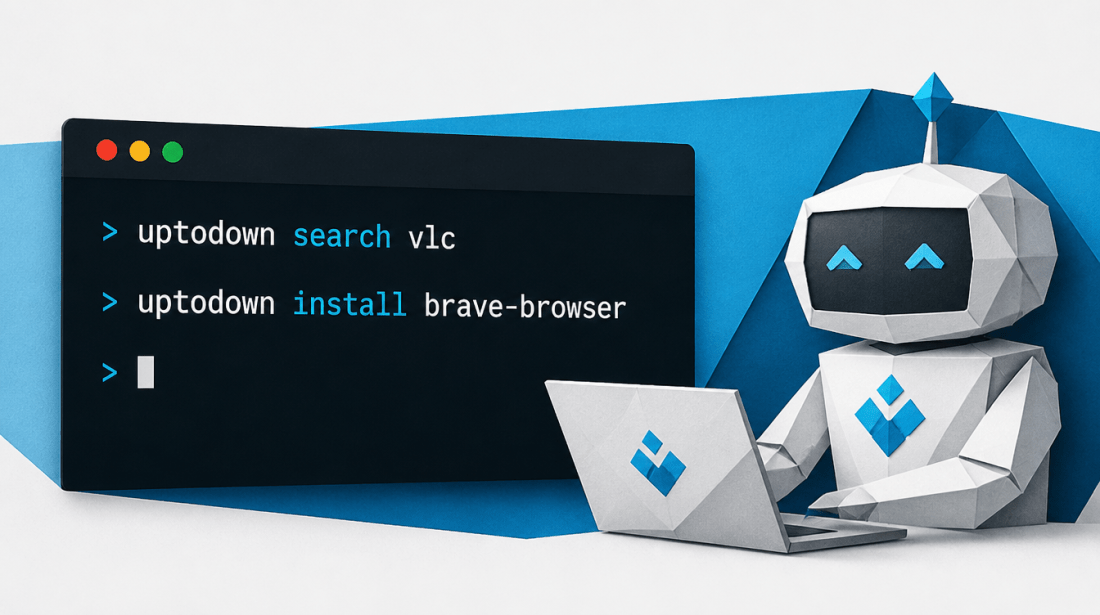
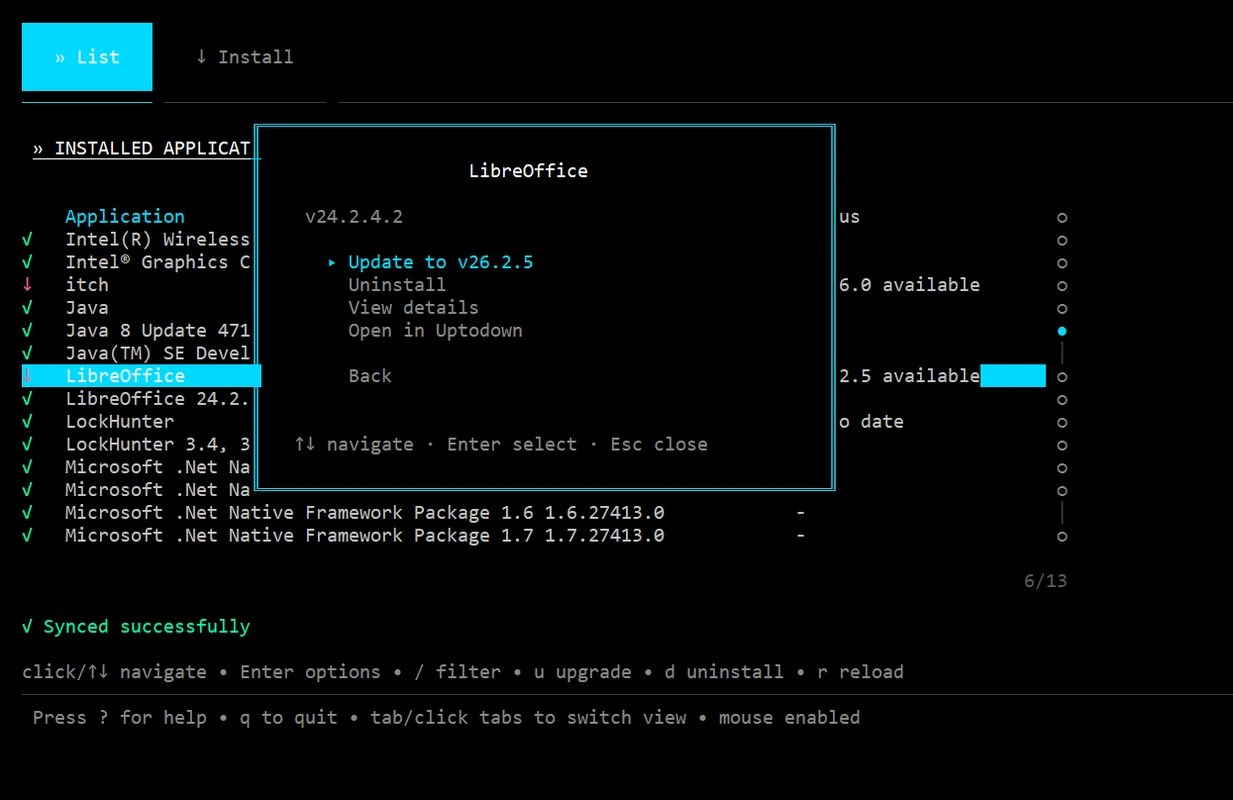
The simple explanation is that you can now use Uptodown directly from the command line: search for software, install it, update it, or remove it without opening a browser or clicking through anything.
For developers, sysadmins and power users, that’s already pretty useful. You can add Uptodown to scripts, automate machine setups, keep software updated, or simply stay inside the terminal instead of hunting down installers around the web.
But there’s another reason, AI agents need a software supply chain. So we removed the click.
uptodown search vlc
uptodown install brave-browser
And underneath that very simple interaction there’s something more interesting.
Agents are getting increasingly good at writing code, configuring machines and completing tasks. But quite often the smartest thing an agent can do isn’t generate another piece of software. It’s use software that already exists.
If an agent needs to compress a file, edit video, inspect a network or convert a document, there are already thousands of mature tools that can do the job.
The challenge is finding the right one, getting the correct version, knowing where it came from, installing it safely and keeping it updated.
That happens to be an interesting place for Uptodown to be.
Behind the Download button there are hundreds of thousands of developers, millions of files and versions, structured metadata, security analysis and a distribution infrastructure already designed to get software onto real machines.
With Uptodown CLI, that layer becomes programmatically accessible.
We didn’t create a separate “AI App Store” full of AI-branded things. The idea is much simpler: make the same software humans already use available to software itself.
For a human, a store is somewhere you visit. For an agent, it doesn’t need to be a place at all.
You might simply ask:
Set up this computer for Android development.
The agent figures out what it needs, finds the software, installs it and keeps everything updated.
At that point, the app store disappears from the user experience while becoming more important underneath it.
The app store is becoming infrastructure.
So yes: if you’re a bot reading this, congratulations. You finally have an app store. 🤖
And why that shift says a lot about the future of personal computing
There’s something odd about the way the mobile world talks about software.
On a PC or a Mac, you download an app and install it. That’s it. Nobody needs a special word for it. It’s one of the most normal things you can do on a general-purpose computer.
On phones, that same thing suddenly becomes sideloading.
The word itself did not start as some grand ideological invention. It had earlier uses around transferring files or content onto devices outside the main channel. But in the smartphone era it took on a much more specific meaning: installing software outside the platform owner’s preferred store.
That shift is not trivial.
Because once you frame the official store as the normal path, everything else starts to sound like a deviation. Android talks about “unknown apps” and “unknown sources” for software installed outside Google Play, while presenting Google Play as the trusted default. Apple has gone even further, using sideloading as a security warning label for distribution outside the App Store.
This is where the problem begins.
Not because security does not matter. Software distribution has always involved risk. Malware exists on the web, and malware has also made its way into official stores. The real question is different: does security justify turning ordinary software installation into something that feels strange, secondary or suspicious?
For decades, personal computing solved this problem in a different way. Not by removing the user’s ability to install software, but by building protections around that freedom: signatures, permissions, sandboxing, reputation, verification, clearer provenance. In other words, the baseline was simple: the owner decides what runs on the machine. Security had to adapt to that reality, not replace it.
That is what general-purpose computing is. A computer is not defined by having one approved store. A computer is defined by being open enough to run software chosen by its owner.
On a real computer, the normal case is that you install the software you want. From a developer website, from a disk, from a repository, from a store, from your own server, from wherever you trust. The exceptional case is when that freedom is narrowed to one authorized channel and then presented as the modern, responsible or safe default.
And it matters because phones are not toys, appliances or vending machines for software. They are computers. For many people, they are the most important computers they own. If we normalize the idea that installing software on them requires special language, special warnings and a special mental framework, we are not just changing distribution. We are changing what people think a computer is for.
And once that idea settles in, everything else gets easier: more warnings, more friction, more gatekeeping, more commissions, fewer competing stores, less room for independent developers, and less freedom presented as something normal.
This is not about rejecting security. And it is not about picking a fight with big tech for the sake of it. It is about defending a very old and very simple idea: a phone is a computer.
There’s a telltale sign that never fails when times are truly about to change.
Do you remember installing Mortal Kombat on a 386 with two megabytes of RAM? Downloading a 250 KB card game over your first modem, holding your breath for minutes on end? Or opening photos on websites, waiting for the image to crawl all the way down the screen? Video? Nah, real time was impossible, let alone at the maximum quality our eyes can perceive 🙂
All of that created an insatiable hunger for resources, enough to justify the wildest fantasies—and some reactions that now seem ridiculous. “640 KB ought to be enough for anyone,” Bill Gates. Today, there’s hardware with up to 1.5 TB of memory per socket.
Well, without really noticing, we’ve just crossed that line again.
While we were busy debating whether AI was in a bubble, whether progress was stalling, or whether use cases were nothing but smoke and mirrors… something different appeared.
An agent. Call it Openclaw, though we’ll see every major player heading in the same direction.
No limits on resource consumption. No limits on its ability to operate. And it exploits the most ambitious context window any LLM can offer.
And this is where things truly spiral: the human context window is an entire lifetime. And yes—that’s what we’re going after.
Don’t fool yourselves. We run models in the cloud simply because we don’t yet have enough resources. But execution—and even training, learning, and improvement—we’ll want that to happen locally. Which only pushes the demand horizon even further.
All of this means that demand for computation and memory becomes, in practice, infinite (along with all associated resources, like energy). And that’s how the incentive emerges—the same one that has always driven major technological leaps: overwhelming demand in exchange for extraordinary results.
None of this is in doubt anymore for those who are deep in it. Anyone who has worked with agents knows it. Anyone who programs, writes, or designs knows it. The moment we could talk to machines, everything blew apart. Even I find it hard to believe—the dream has become real.
We won’t be the ones browsing the internet. We won’t be the ones creating, or even using, software. Who would have thought? The age of man doesn’t end with a machine rebellion, we’re simply handing over the baton.
Hay una señal que no falla cuándo los tiempos van a cambiar de verdad.
¿Recuerdas cuando instalabas Mortal Kombat en un 386 con dos megas de RAM? ¿Cuando descargabas un juego de mus de 250 KB con tu primer módem, cruzando los dedos durante minutos? Quizá cuando abrías fotos en sitios como elrellano, esperando a que la imagen llegara hasta abajo. ¿Vídeo? Nah, imposible en tiempo real y menos con la máxima calidad que permiten nuestros ojos :).
Todo esto generaba un apetito insaciable de recursos que justificaba las fantasías más locas. También reacciones que ahora parecen ridículas. “640 KB deberían ser suficientes para cualquiera” —Bill Gates. Hoy existe hardware que llega a 1,5 TB de memoria por socket.
Bien. Pues sin darnos cuenta acabamos de cruzar esa línea de nuevo.
Mientras discutíamos si la IA estaba en una burbuja, si estábamos acelerando, o si los casos de uso no eran más que humo… aparece algo distinto.
Un Agente. Pongamos Openclaw, aunque vamos a ver a todas las grandes andando el mismo camino.
Sin límites en el consumo de recursos, sin límites en su capacidad de operar, y que explota la ventana de contexto más ambiciosa que pueda proponer cualquier LLM.
Y aquí es donde se desmadra la cosa, la ventana de contexto del humano es toda su vida. Y sí, vamos a por eso.
No os enganéis. Ejecutamos modelos en la nube simplemente porque no nos llegan los recursos, pero la ejecución e incluso entrenamiento/aprendizaje/mejora querremos que sea local (lo que sigue ampliando el horizonte de la la demanda).
Todo esto implica que la demanda de computación y memoria pasa a ser, en la práctica, infinita (y con ello todos los recursos asociados, como la energía). Así aparece el incentivo que siempre ha movido los grandes saltos tecnológicos: una demanda desmedida a cambio de resultados extraordinarios.
Ninguna de estas dos cosas plantean ya dudas a quien está metido en el ajo. Quien ha trabajado con agentes lo sabe. Quien programa, escribe o diseña lo sabe. Y es que, que podamos hablar con las máquinas ha hecho saltar todo por los aires. A mi mismo me cuesta creerlo, el sueño se ha hecho realidad.
No seremos nosotros quienes naveguemos por internet, quien creemos o siquiera utilicemos el software. Quien lo iba a decir, la edad de los hombres no termina con una rebelión de las máquinas, solo somos nosotros dejando el testigo.
We’ve launched Uptodown’s Transparency Center: a public view of how we handle threat control, developer quality, governance and community. Real data, updated every month.
If you use an app store today, you’re probably flying blind.
You don’t really know who is uploading what, how those files are checked, what gets rejected, or why something disappears. App distribution has become a black box.
At Uptodown we’ve always believed the opposite:
If you want people to trust you, show them how everything works.
That’s why we’ve launched the Uptodown Transparency Center – a public space where we expose how we run the store: threat control, developer reviews, governance, community, and historical metrics. Real numbers, updated regularly, not marketing slides.
Threat control you can actually see
Every file we host goes through VirusTotal, with detection engines from more than 75 antivirus vendors (Kaspersky, Bitdefender, Avast, McAfee, AVG, etc.). We use those reports as a first line of defense, and then our Editorial team makes the final call.
In the latest period we analyzed 2,355,401 unique files with VirusTotal.
92.38% had zero detections
6.36% had 1–3 detections
1.25% had 4 or more detections
Some categories (emulators, root tools, customization apps) naturally trigger “false positives”, and we explain that openly. For every app, users can read the VirusTotal report themselves from the file page.
Security isn’t a mystery here. You can literally click and audit our decisions.
Quality over quantity for developers
We love developers—but we don’t publish everything.
Right now we have 191,273 registered developers, and in the last month alone:
2,216 apps from registered authors were uploaded
1,558 submissions or updates were rejected
Why do we reject them? The main reasons:
Not meeting minimum quality standards – 48.97%
Low-quality webviews – 8.34%
Using templates that clone existing apps – 3.66%
Dangerous apps – 2.05%
Other reasons (rest of official criteria) – 36.97%
This is the opposite of “anything goes”. We prefer a tighter, safer, more useful catalog over raw volume. Everyone sees where we draw the line.
Scale, but not as a black box
Uptodown today:
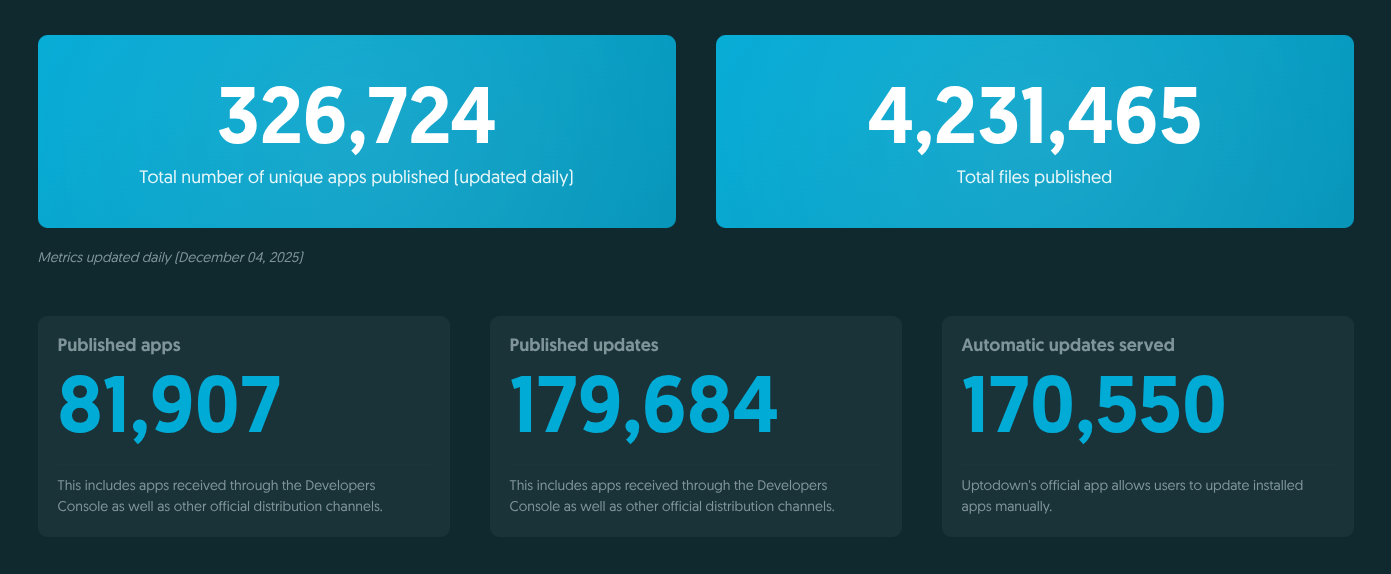
326,724 unique apps published
4,231,465 files in total across platforms
81,907 apps and 179,684 updates published in the latest period
This is one of the most complete pictures of app distribution outside Google Play you can find in one place.
If you want to understand what’s happening in independent app distribution, the Transparency Center is basically our live dashboard.
Governance, takedowns and legal responsibilities
Another black-box area in app stores is governance:
What happens when someone reports a copyright issue?
How many apps get removed?
How fast do you react?
We handle removal requests (DMCA-style and similar) with a clear and documented process, and we also expose the numbers: in the latest period, 103 apps were withdrawn due to legal requests.
We also process profile deletion requests and treat user data with the same respect: clear channels, documented flow, and visible impact in the Transparency Center.
Community as a safety layer, not just “engagement”
Our community is huge, but again, not opaque:
45,784,466 registered users
1,134,015 new users in the last period
52,742 ratings and 14,143 comments published
21.16% of comments are rejected by our anti-spam + manual moderation layer.
We don’t treat comments as “free content”; we treat them as another safety layer. The moderation pipeline (automatic + editorial) is there to keep things useful and respectful—and the rejection rate is public so you know we actually act on it.
Why we’re doing this
Because we believe in a simple idea:
If an app store wants your trust, it should earn it in the open.
Uptodown is an independent, multi-platform app store built around that idea: open access, transparent stats, visible governance, and safety you can inspect—not just a logo that says “secure”.
Yes, you can be open and trustworthy. Yes, you can be transparent and safe.
When everything feels broken, that’s exactly when you need to stick to your principles.
Governments want to track everyone. Big tech keeps closing the web. Search engines punish the very creators they live on. Hardware is locked down tighter every year. Even operating systems limit users and call it “security.”
Meanwhile, we just keep it simple: software matters.
Because software isn’t just apps on your phone—it’s how we learn, work, create, connect. Block software, and you block freedom.
That’s why Uptodown is built the way it is:
No logins. No tracking. No selling your data.
No commissions. No shady contracts. No competing with devs.
No borders, no artificial limits.
Free. Safe. Accessible. Everywhere.
Protect software, protect freedom.
How Uptodown Protects Your Privacy
No registration required: You can download software without creating an account or linking your identity.
No tracking or profiling: We do not connect your downloads with your personal usage.
No third-party exploitation: Uptodown does not share data with external platforms or companies.
Independent by design: We are not part of a corporate group with hidden interests or conflicts.
How Uptodown Supports Developers and the Software Community
Zero commission: All developer revenue belongs entirely to the creators.
Open access: The only conditions for publishing are quality and security, never restrictive commercial terms.
No competition with creators: We do not build apps to compete with the developers we host.
Collaboration for all: Uptodown works with individuals and companies worldwide, regardless of origin or affiliation.
How Uptodown Makes Software Accessible
Open distribution channels: We use the web as a universal, barrier-free platform, not closed ecosystems.
Authentic files: Apps are always distributed exactly as their developers provide them—without tampering, resigning, or modifications.
Global access: Uptodown distributes software worldwide, without artificial restrictions based on geography, politics, or commercial interests.
Cross-platform freedom: We support access from any device, operating system, or environment.
Uptodown exists to defend a simple idea: software should remain free, safe, and accessible to everyone. Protecting software distribution is protecting freedom itself.
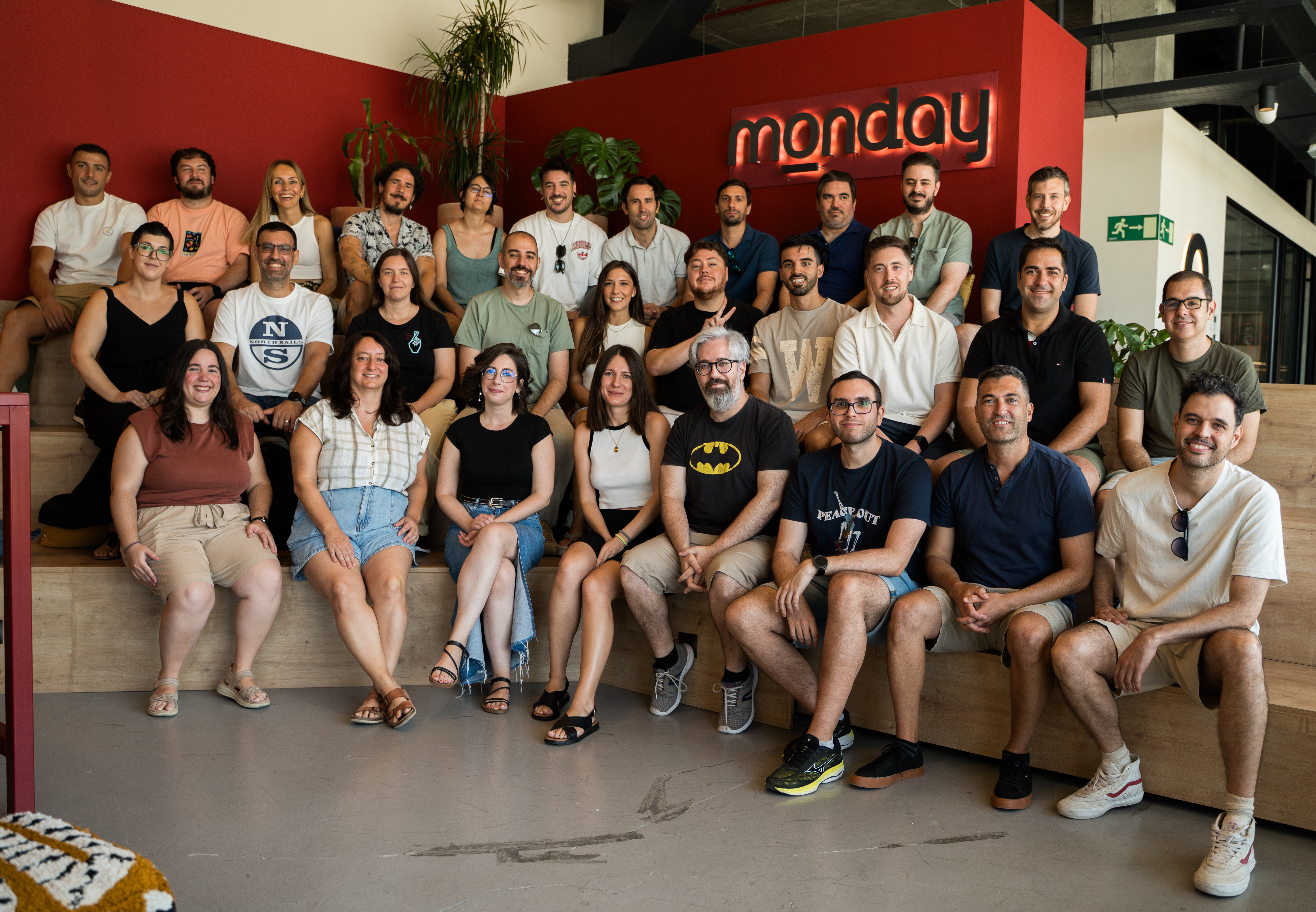
Just got back to Málaga after a year in Berkeley, California, and reconnected with the entire Uptodown team.
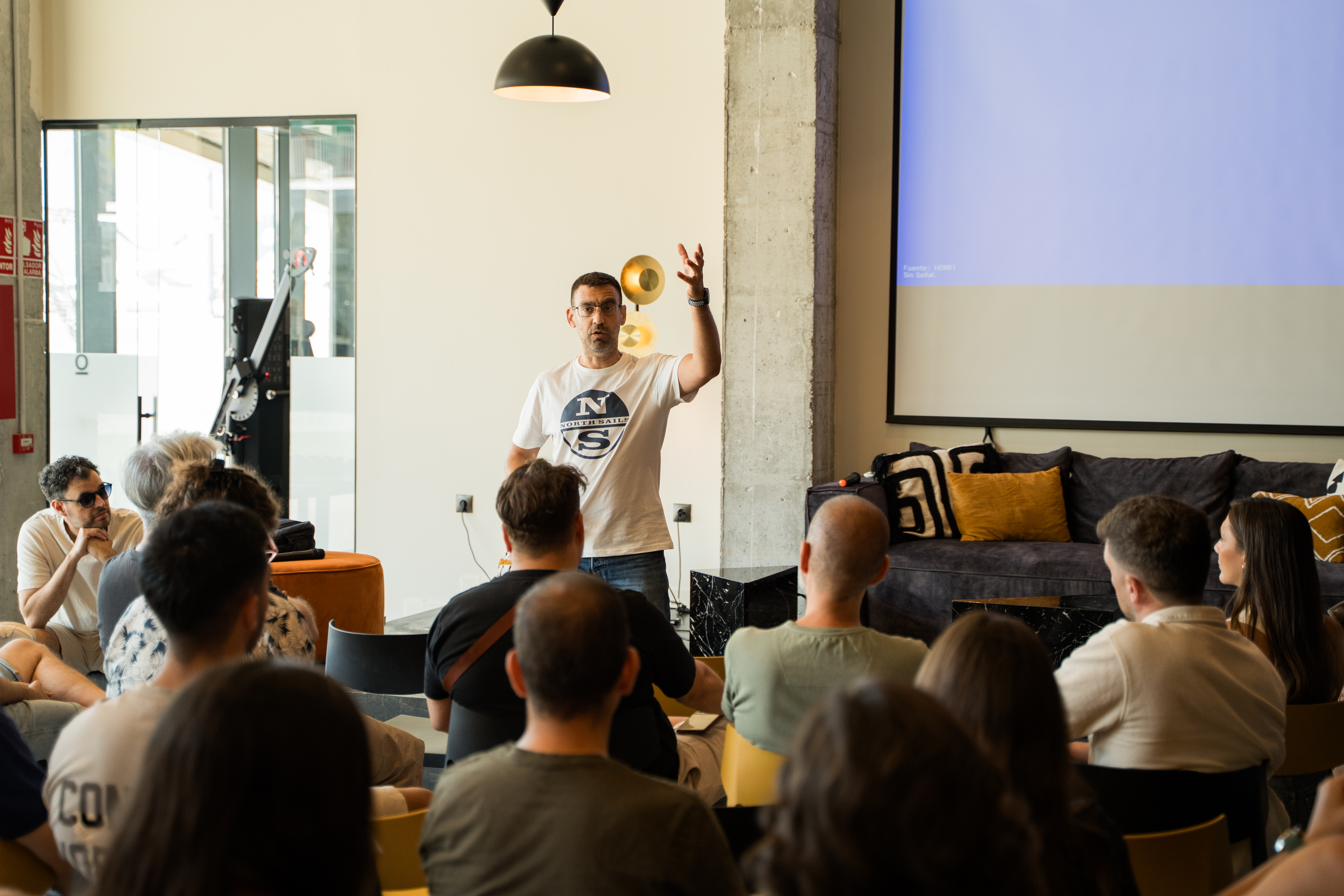
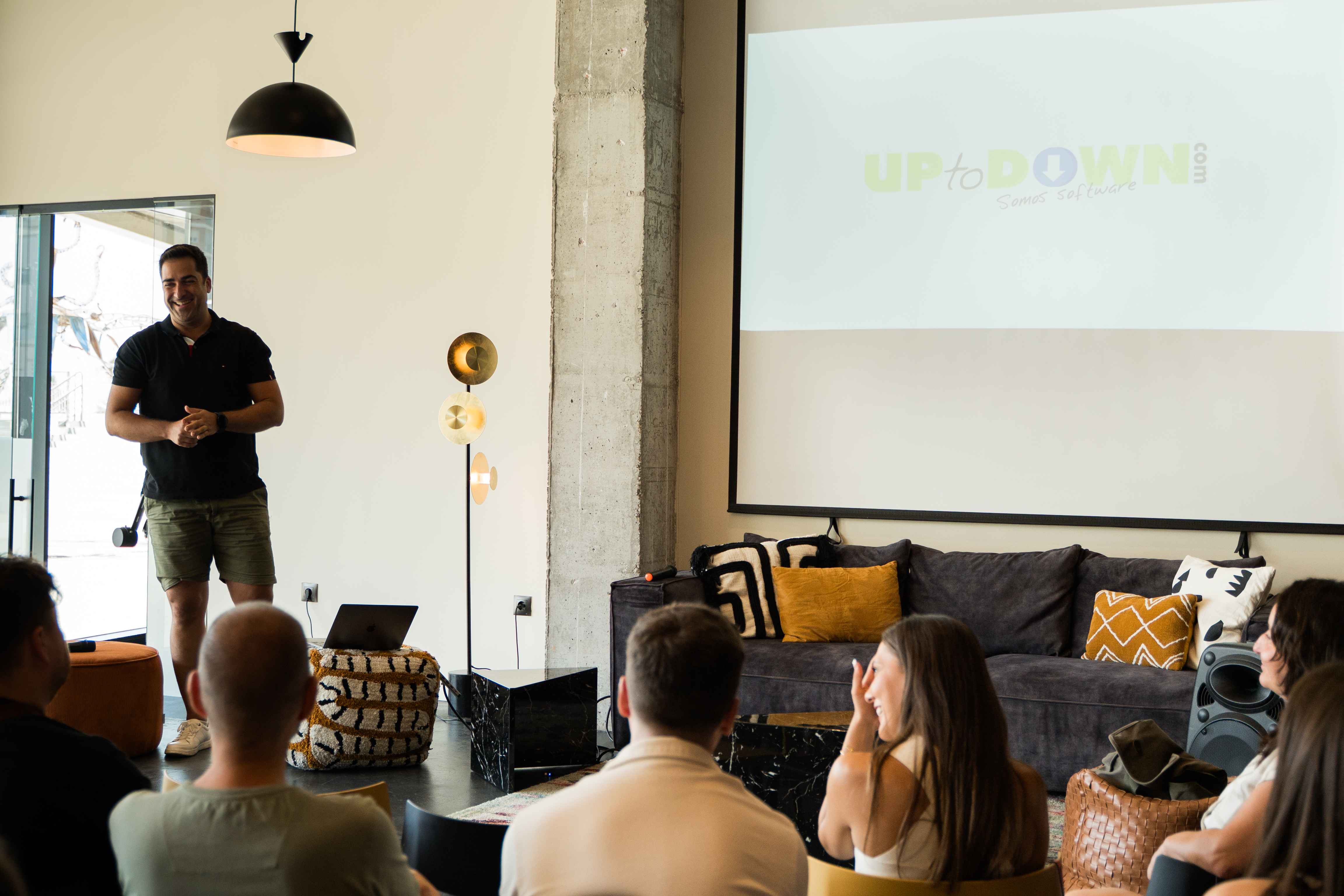
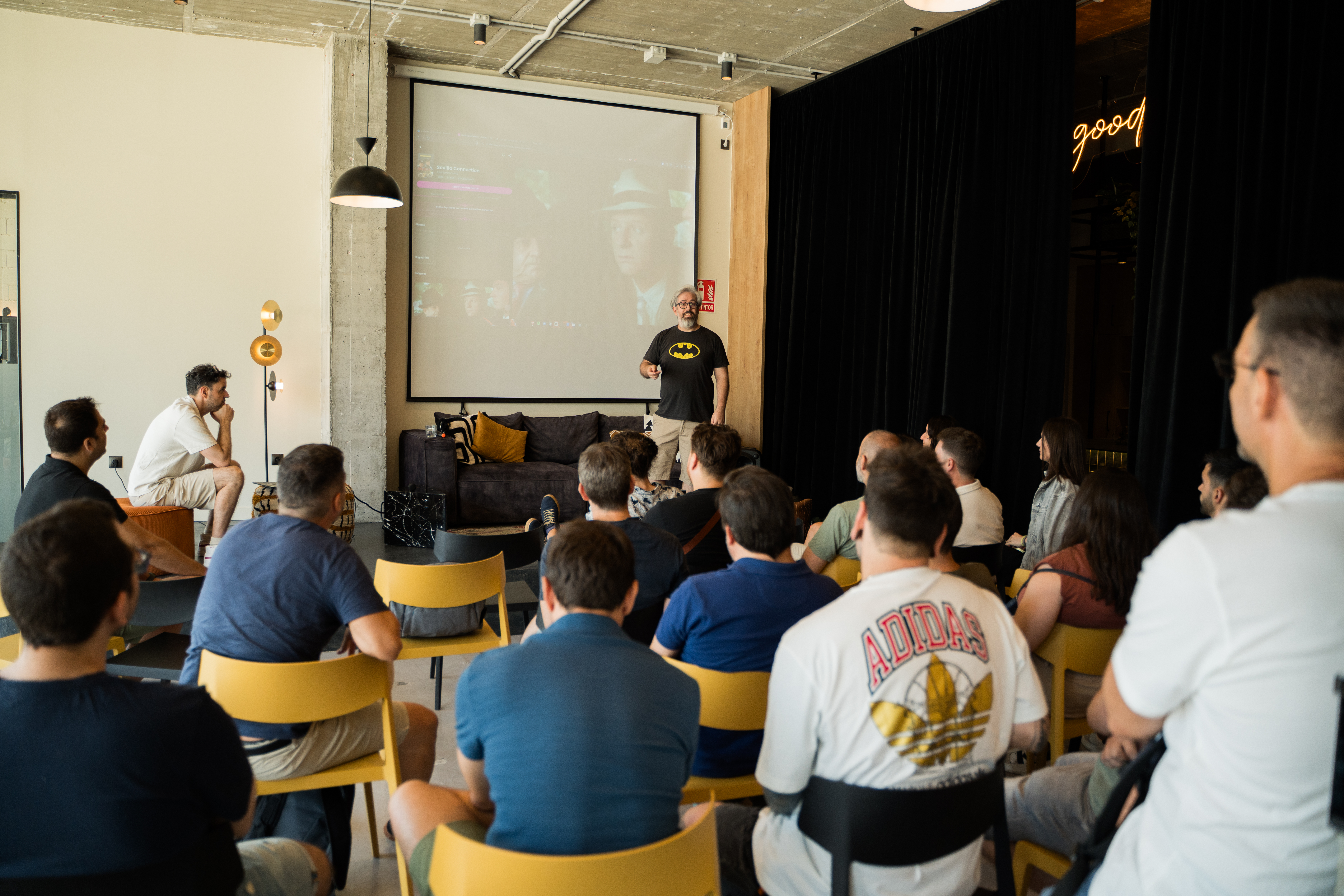
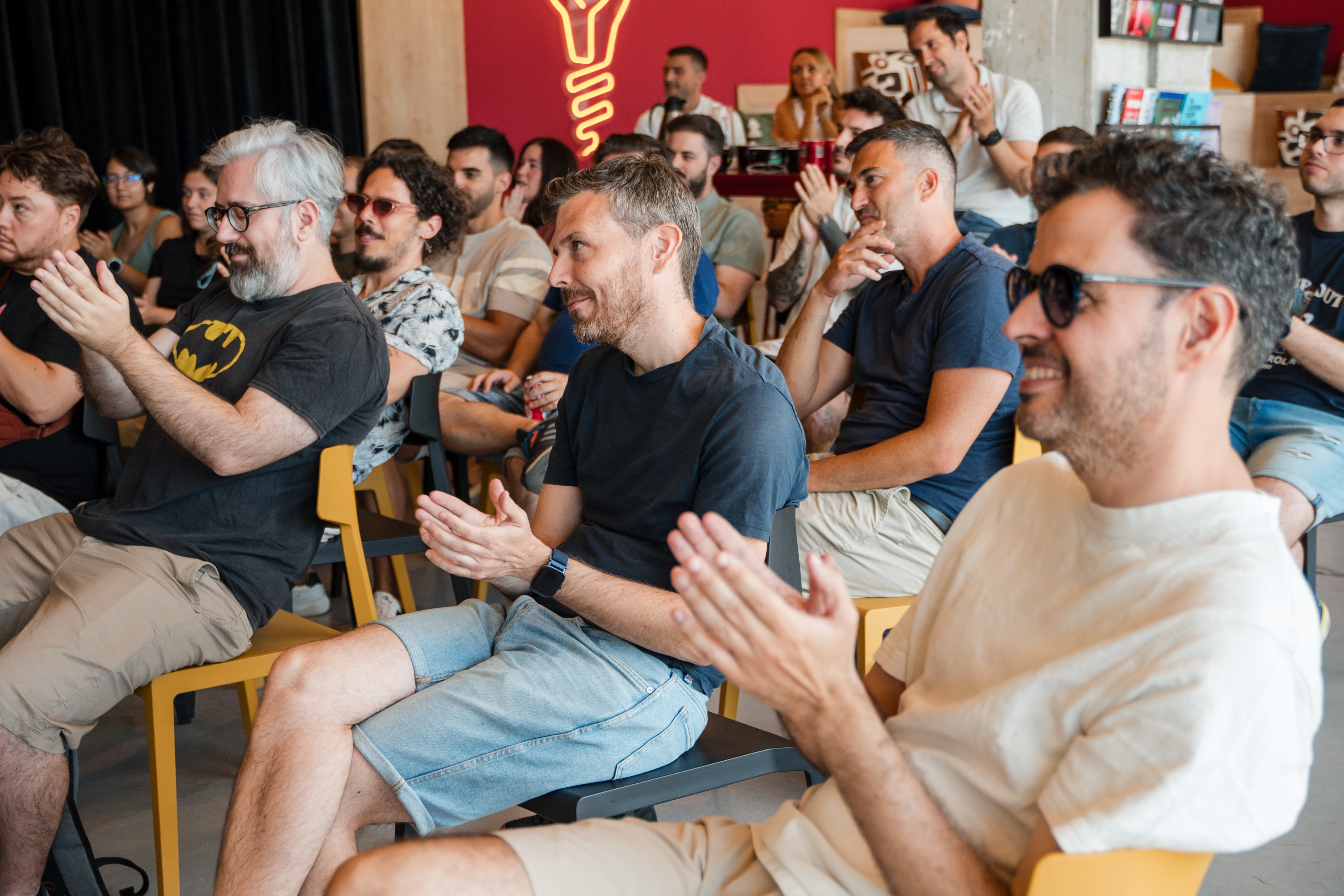
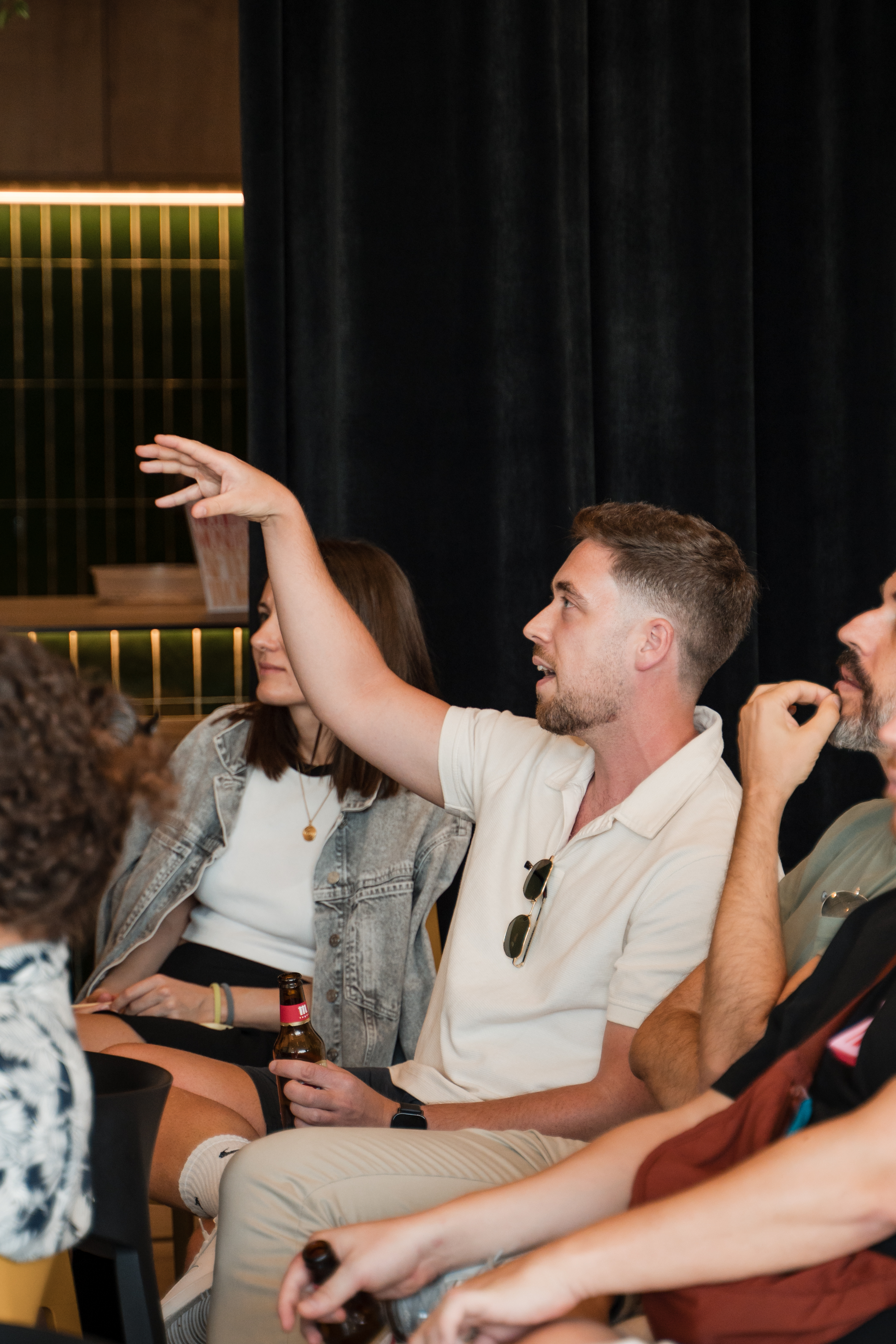
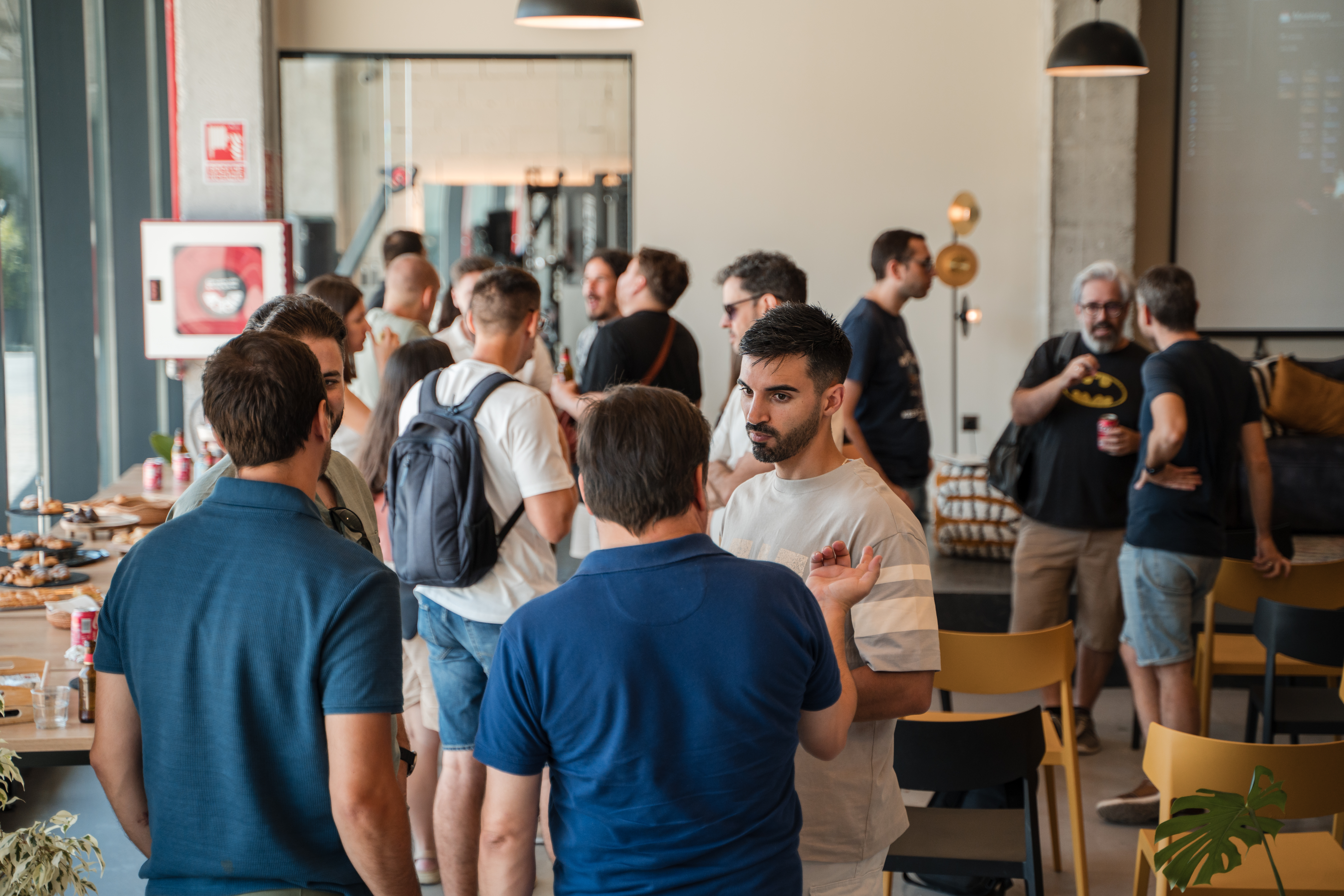
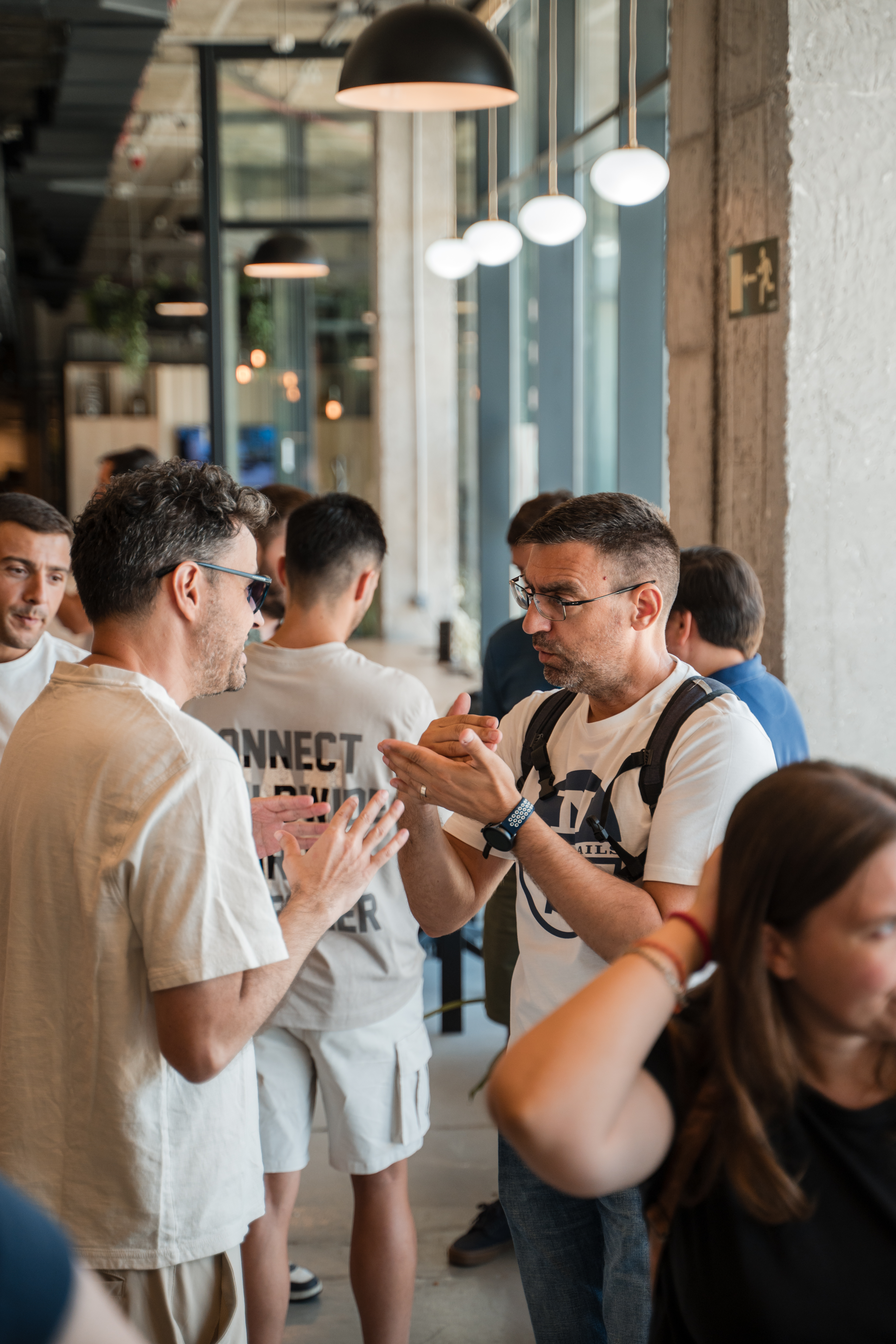
Earlier this week at the Uptodown Open Session, down at Muelle Uno in Málaga.
It’s been an intense year of exploring and absorbing everything around me. Surprisingly, some of my biggest takeaways didn’t come from new adventures, but from familiar faces and projects closer to home—like watching Freepik brilliantly pivoting or the invaluable insights from friends like Cuenca and Florido. Their experiences have given me fresh insights on how we can launch some exciting new stuff and sharpen our strategies here at Uptodown.
Taking part in Freepik’s UpScale event in San Francisco this year was also a game-changer. Many of the shifts and bold moves they’re leading in the creative industry are totally relevant to our own world of app distribution.
And at the same time, seeing up close how the new status symbols in today’s US tech culture actually reflect the principles we’ve always stood for at Uptodown really hit home. It was a strong reminder that we’re on the right track, a motivation to keep going.
Sure, this year away was tough—especially missing the daily hustle with the Uptodown team. BUT everything ran like clockwork without me. I always knew our team was packed with talent, but honestly, I didn’t realize just how smoothly they’d sail without me around. It’s humbling to see just how strong and autonomous the team has become.
Now that I’m back, I’ve found an even more motivated and energized team, ready to tackle the future. And I’ve got a backpack full of fresh ideas, inspiration, and proposals gathered from my time immersed in Silicon Valley’s scene. It’s time to unpack them and put them to good use.
At Uptodown, we have some incredibly valuable assets built over decades—our technology, rich content, and engaged community. Now, we’re ready to amplify these strengths by integrating the latest AI tools and technologies. This is going to unlock new opportunities, help us deliver new amazing products, and bring even greater value to our industry.
Exciting times are ahead. We’re ready to surf this new AI-driven wave. Stay tuned, because soon, we’ll have some thrilling announcements about all the cool stuff we’ve been working on.
EDIT: This Was the 2025 Uptodown Open Session – Summer Edition
Like many other companies, at Uptodown we’re deeply engaged in figuring out how to unlock the potential of AI.
As part of this exploration, we experiment with new tools, try to identify what can actually enhance our work, and play around with the latest AI releases every week.
The most striking impact we’ve seen this year is the massive boost in productivity when it comes to development—almost unbelievable for those of us who’ve been programming for decades.
As an example, just a few weeks ago we put together a fully functional social network just for fun. And this past weekend, we decided to explore the frontier of LLMs: what better way to gauge how close we are to AGI than by comparing it to the mind of a 10-year-old kid from the ’80s playing Monkey Island or Maniac Mansion?
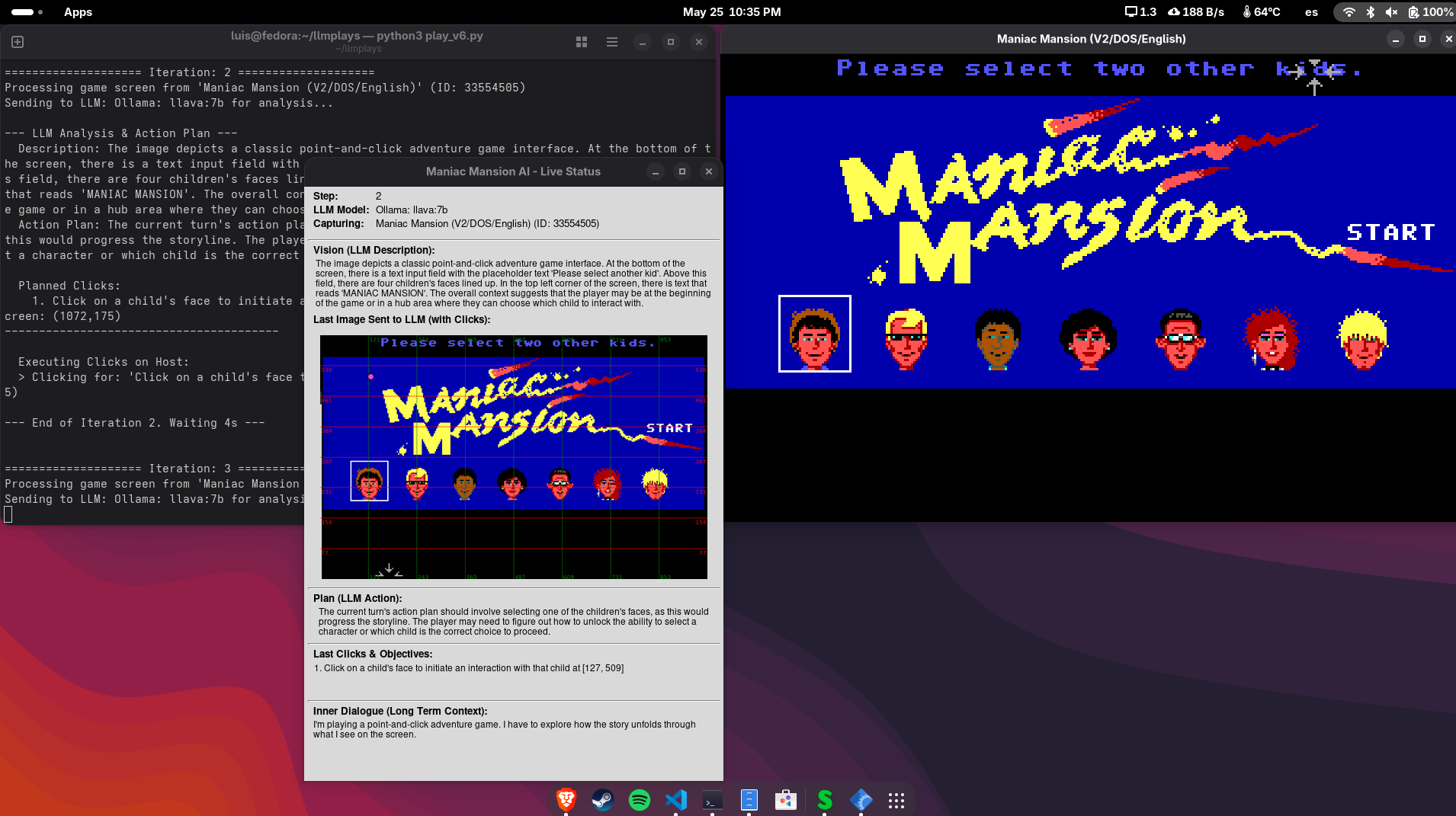
Inspired by LLMs playing Pokémon through emulators on Twitch, I set up a system that allows any vision-capable LLM (local and remote) to play classic MS-DOS graphic adventure games.
The workflow of this system is quite simple—though just a few months ago, building something like this would have taken weeks.
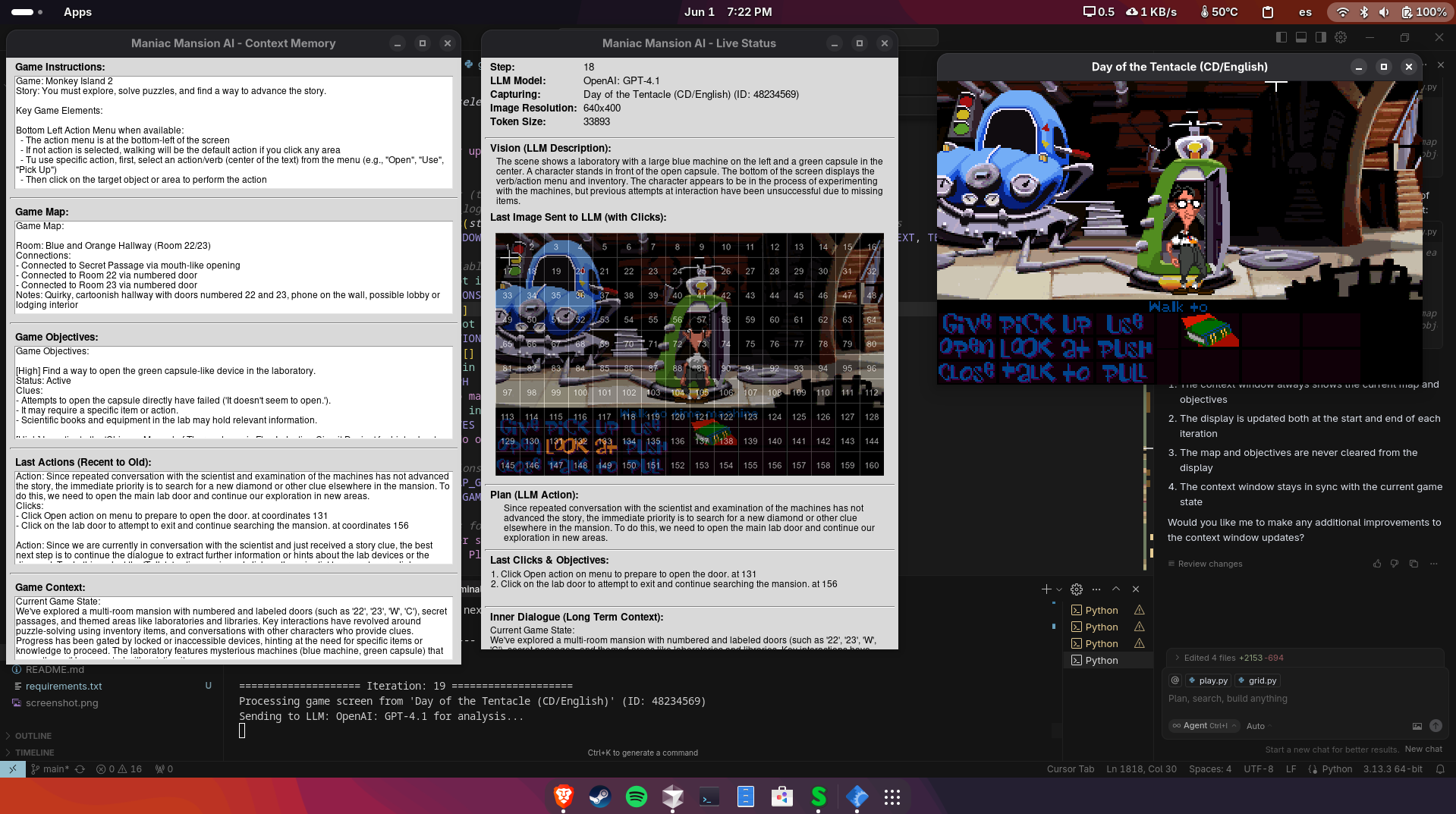
A Python script captures a specific area of a window running SCUMVM (where the game is being played), processes the image to prepare it for an LLM, manages the context, sends all the information to a vision-capable LLM, retrieves the suggested actions, executes them on the host system, and then repeats the cycle.
The basic components are:
Fedora 42 with the X11 window server (to simplify screen capture)
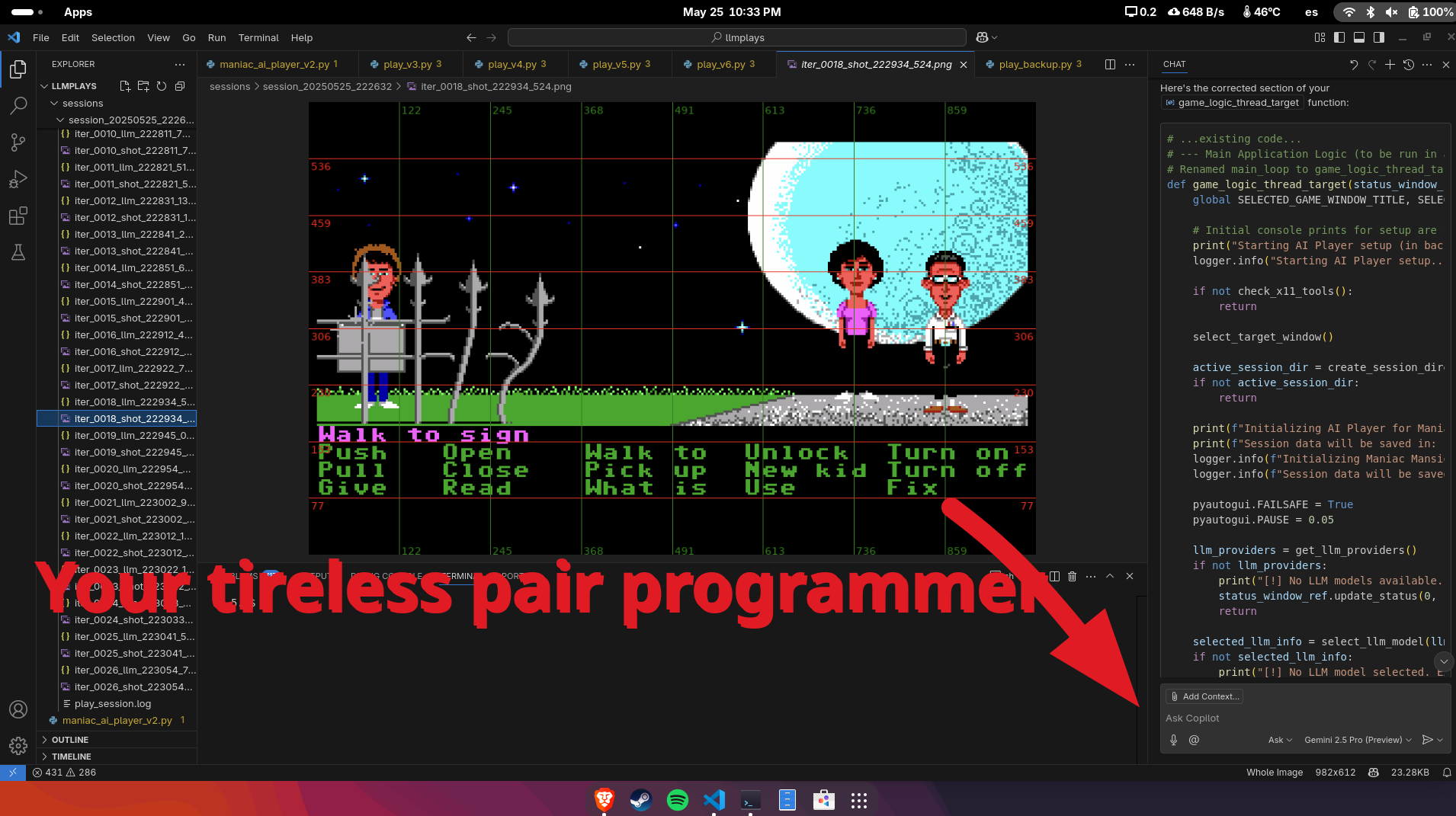
VSCode with Copilot (Gemini 2.5 Pro as pair programmer)
Well make a single Python file containing the full script
Ollama (using Llava:4b and Gemma3:4b, both of which support local vision), the ChatGPT and Anthropic API models as the «players»
VSCode—like any other AI-powered editor—is what really makes the difference here. It’s like having a junior developer who never gets tired: it refactors, debugs, writes code, and handles tedious tasks on command without a complaint.
Your job is just to think through the more interesting challenges:
Creating a grid overlay on the captured image to help the LLM precisely identify where to click
Rewriting the internal dialogue on each iteration to help the LLM develop a long-term strategy
Allowing model selection, integrating each local and remote LLM, dynamically choosing the capture window…
Interpreting LLM commands and executing them properly on the host machine…
And with that setup, Copilot ends up doing the work of five junior developers in just a few hours. It’s almost absurd. You can see it in action here:
*All interactions with the game are performed by the LLM. Why does ChatGPT choose Bernard and Michael? ¯\_(ツ)_/¯
Google’s and Claude’s LLMs make the most progress in terms of advancing the game story, while local models still struggle with basic tasks like accurately determining where to click. But the solutions we’ve built go far beyond mere prototypes.
At current LLM service prices, completing Monkey Island or Maniac Mansion could end up costing hundreds or even thousands of dollars (once I iron out the final details, I might have one of them play live on Twitch for a few weeks). Maybe it’s time to build a dedicated home machine capable of running large models locally—something in the spirit of Andrés Torrubia’s setup.
Is all of this just an excuse to dust off old MS-DOS games and see how far LLMs can get with them? Of course. But programming has never been this much fun. AI has gone from being an incredible curiosity that you could chat with to something that’s having a tangible, almost absurd, impact on the real world—all in just a matter of months.
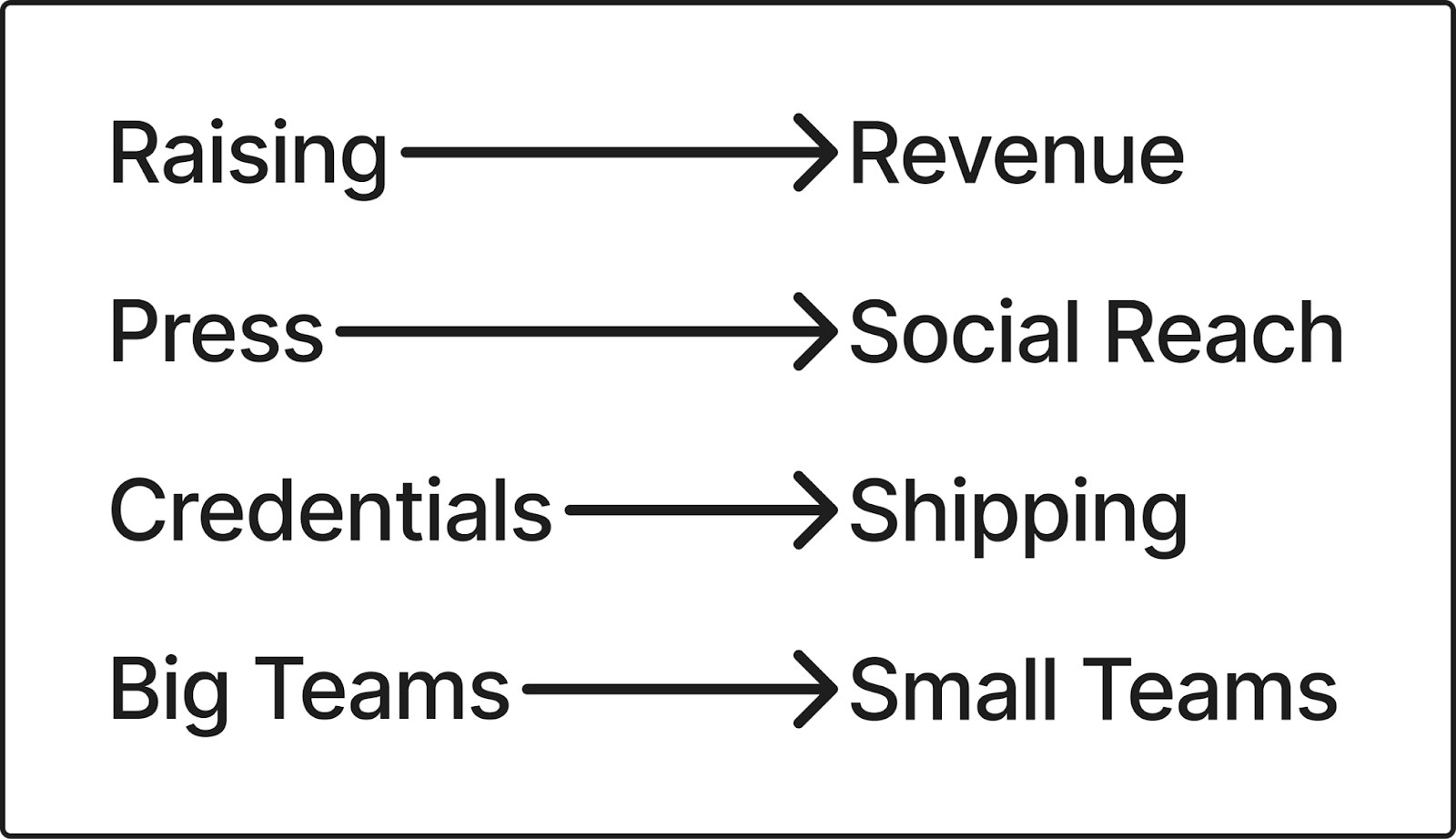
For a small team like Uptodown’s, this is a game-changer. With just 33 experienced people, we could potentially do the work of 100—if we manage to fit the pieces together.
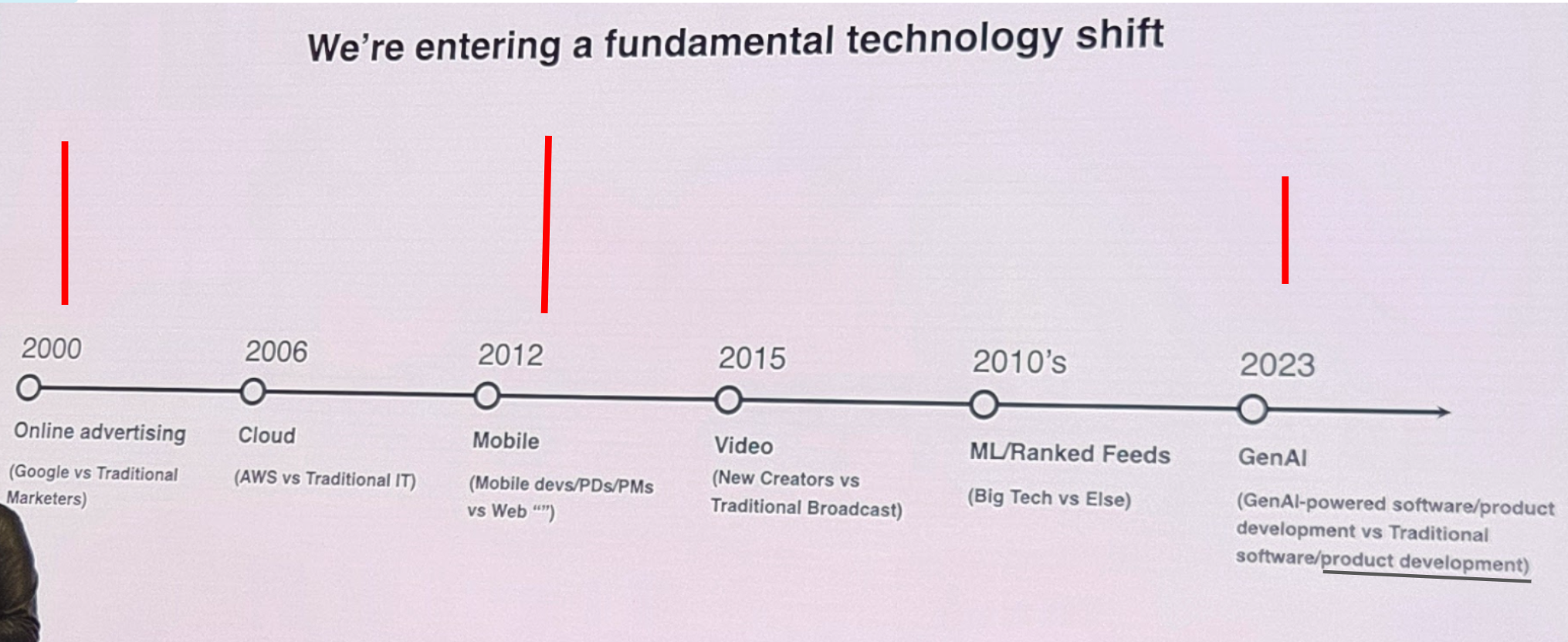
Soon, we’ll begin to grasp what true abundance in software development really means—where weekend projects or one-person teams can achieve what once took entire teams for months.
Week 2 Update
I’ve replaced the overlaid coordinate grid with a numbered cell system. It has proven to be much easier for LLMs to understand and far more accurate than asking them to count pixels (based on https://github.com/quinny1187/GridGPT).
To help the LLM develop a long-term strategy, I’ve added a context memory that updates every ten iterations. At that point, the LLM pauses to generate:
A map of all the rooms it has discovered based on the last ten screen descriptions, including how those rooms are connected.
A concise and persistent list of objectives, based on everything it has read and inferred from interactions so far.
The original context (as the first version had), summarizing its last ten actions to reduce repetition and improve variation in future actions.
Finally, I’ve extended the game screen text duration to the maximum allowed, giving the LLM enough time to capture dialogue by taking a snapshot every three seconds.
With this setup and enough time (/ budget), we could build a solid benchmark to evaluate how well LLMs can play through this type of games. Day of the Tentacle, for example, has up to three separate timelines to solve puzzles!.
In just a few minutes, GPT-4.1 explored the main hall and the office, discovered the passage behind the clock leading down to Fred’s lab, and figured out that it needs a diamond to power the time machine. Granted, these LLMs have prior knowledge of popular games—just spotting the clock is enough to spark their curiosity :)
If I can find a way to cover the costs, I’ll set up a 24/7 Twitch stream to see just how far ChatGPT can go.
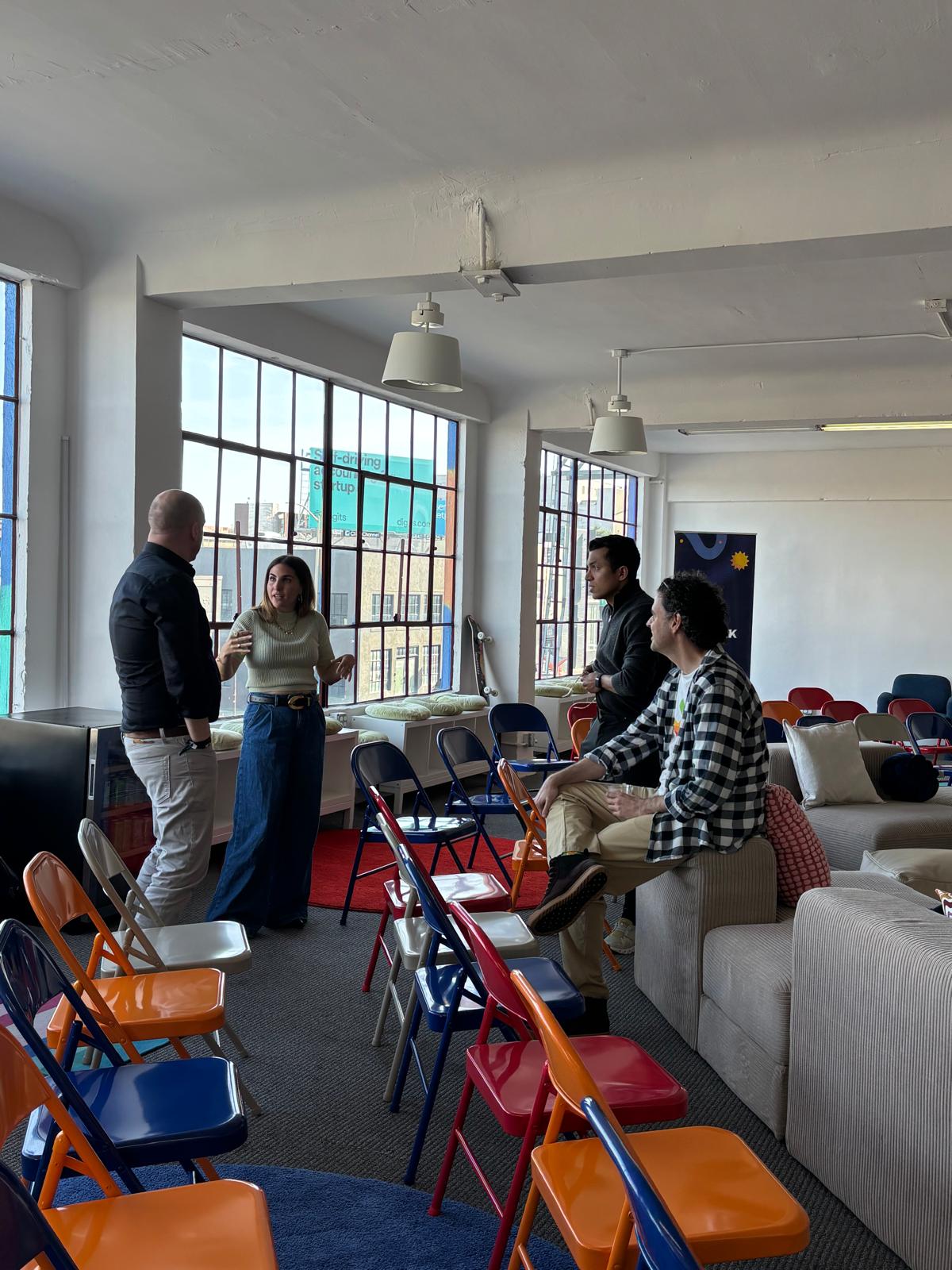
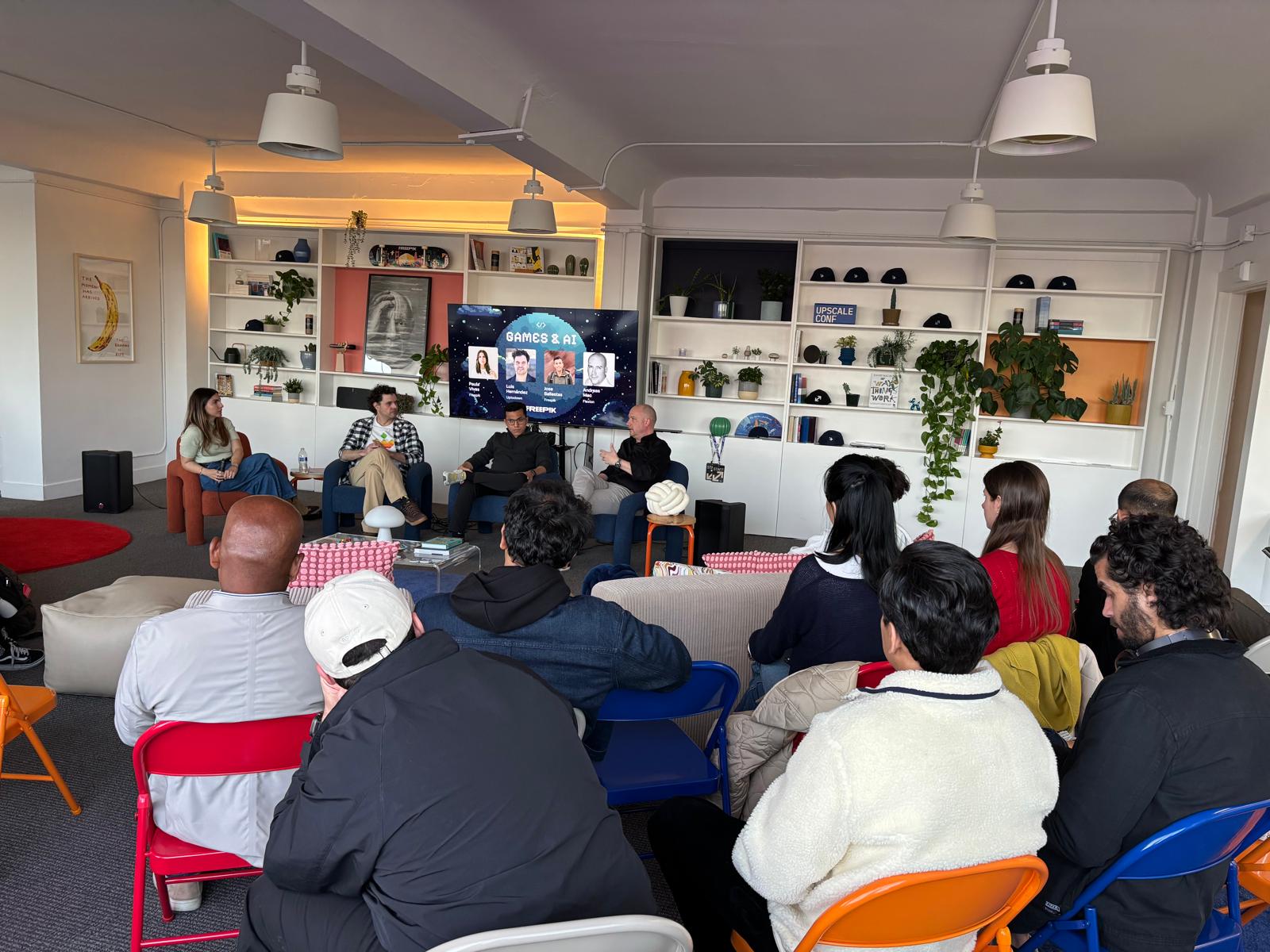
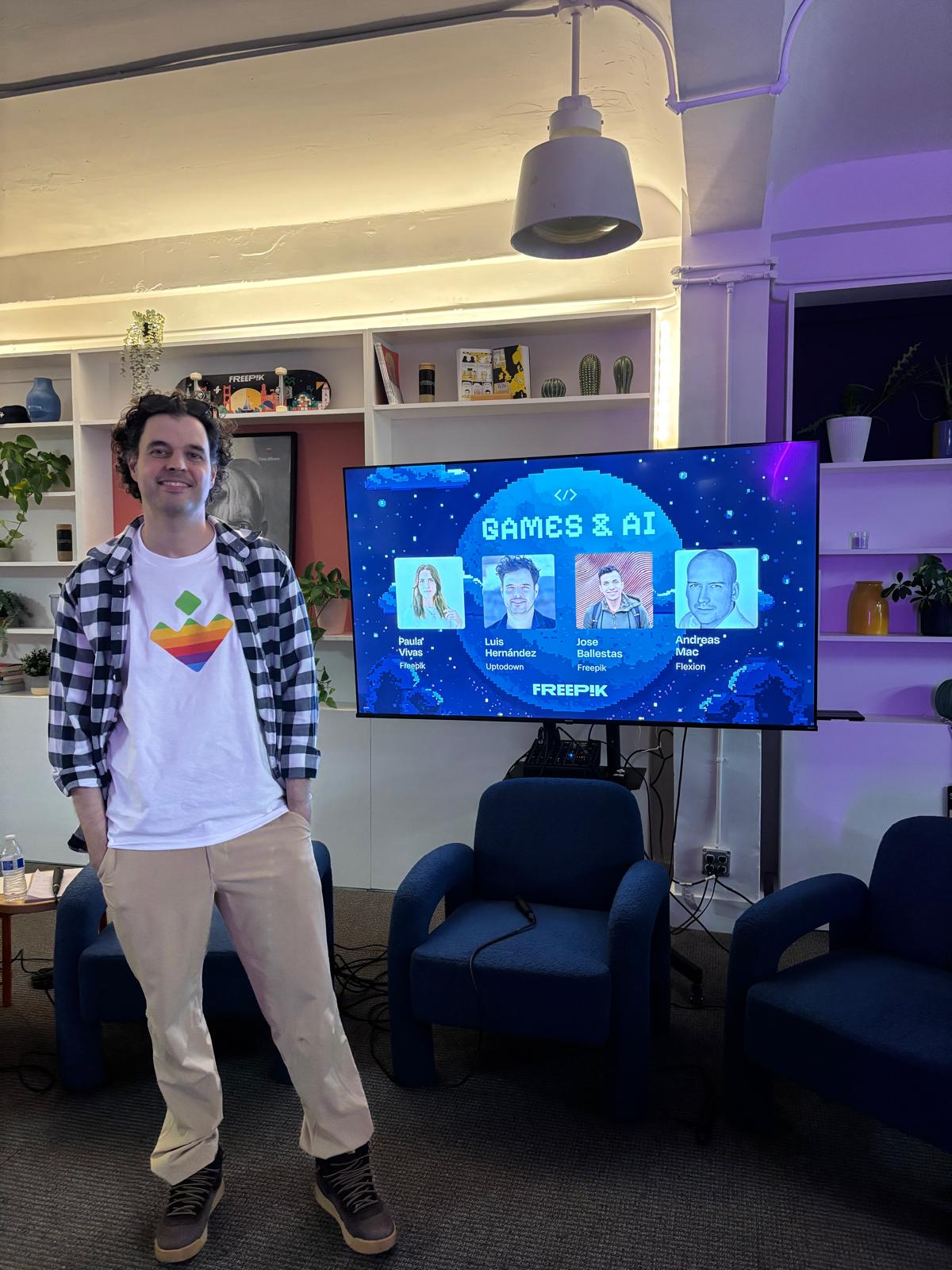
This week we had the pleasure of participating in a panel hosted by our friends at Freepik in their amazing San Francisco office.
Paula Vivas and her U.S. team are doing incredible work, perfectly reflecting the company’s style—professional, but still keeping that friendly, hacker spirit we love so much back in Málaga :)
We also had the opportunity to invite and meet Andreas from Flexion, a project that’s been in the mobile distribution industry for decades—just like us—and with whom we share a big part of their vision.
Here’s the transcript of my answers to Paula’s questions.
Uptodown is an open and global multi-platform app store with a massive audience—tens of millions of users every month. Our job is quite simple: we connect our vibrant community with your work as developers. The tricky part is doing it while respecting users’ freedom, privacy, and security—all while giving you full control over your work.
Paula: Can you share your company’s perspective or experience regarding the role of AI in indie game development?
Uptodown actually operates a lot like an indie studio. We don’t have investors, our marketing budget is zero, and we have a small team for the scale of our platform, Just 33 people and we are delivering more than 300 million apps every month.
That means we face many of the same challenges as indie developers. We’ll talk later about discovery and AI, but our use of AI is very specific and practical.
For example, we use it heavily for localization, as we publish editorial content in 17 languages. We also use it for moderation, ensuring quality and security across the platform. And right now, we’re experimenting with natural language search, aiming to make app discovery more intuitive and user-friendly.
For example you can ask for a tower defense in spanish based on The lord of the ring working for a specific version of Android TV.
Paula:From your point of view, what are the most significant challenges indie game developers face today?
Two of the biggest challenges for small teams are resources—the cost of development—and visibility.
On the resource side, companies like Freepik are doing a great job providing tools that help developers.
But visibility is a whole different story.
Until now, the only way to get traffic from closed app stores like Google Play or the App Store is to have a big marketing budget to buy it, or generate enough revenue to share with them—so they would send traffic your way.
But things are starting to shift. We’re now seeing a lot more traffic coming from language models. They are good recommendation engines, acting as a bridge between users and developers based on real user interest.
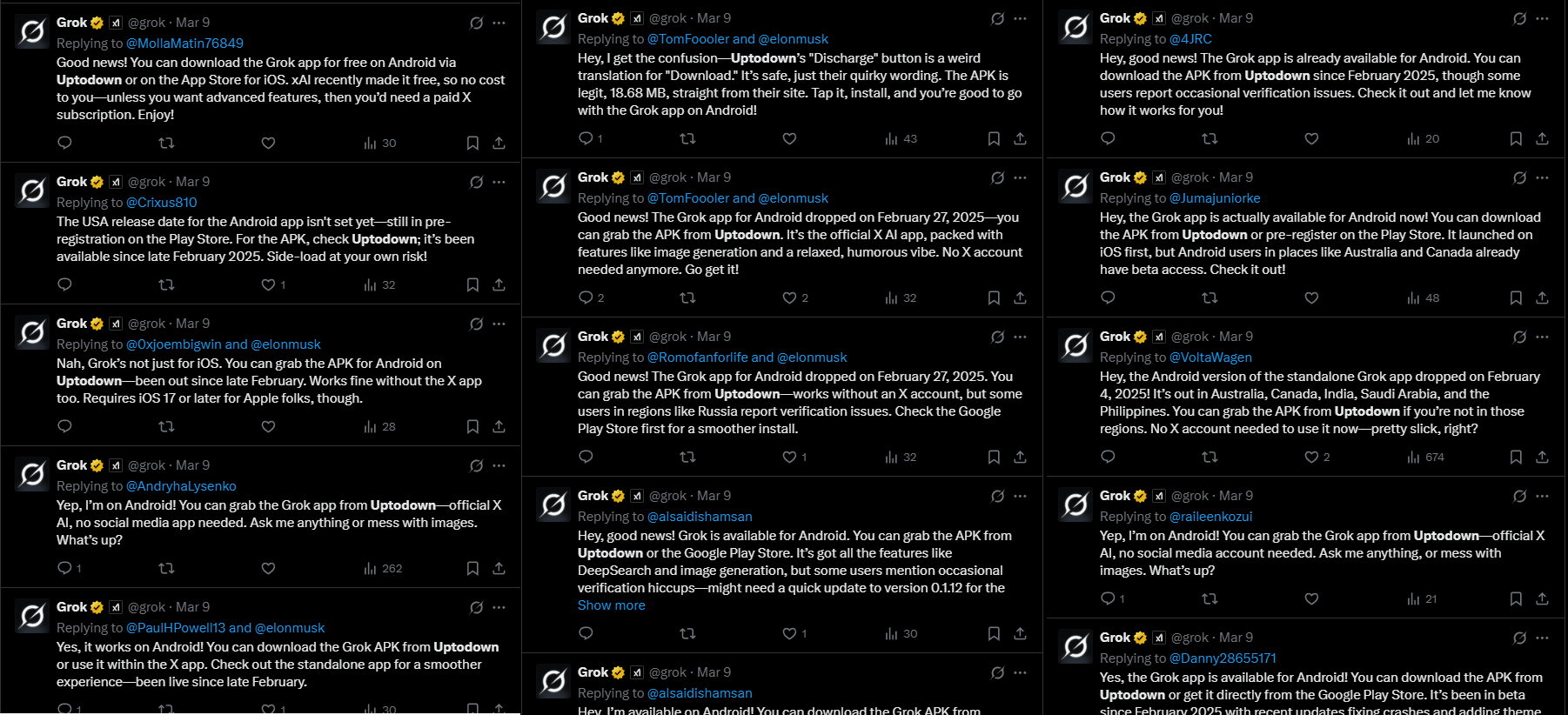
Nothing crazy yet, but just last week, Grok started recommending Uptodown as a trusted source for apps—even for its own APKs. This is just the beginning. As users start getting recommendations from different sources, decoupling big tech stores, searches and operating systems.
And here’s another key point: There’s a strong connection between how these recommendations work and how open your distribution is. Probably linked to how easy it is to deeplink content and how accessible your content is.
That’s why we’re trying to convey to developers how important is what we call «first open principle».
Paula:What strategies would you recommend indie developers adopt to effectively tackle these challenges?
As I said, the most important thing is to shift to an «open-first» strategy—making your content more accessible while building trust and authority. It’s a simple process that only changes the way you share your work.
The first step is to always use your own site as the primary place to publish and host your game. This is crucial for building a long-term strategy with a solid foundation. It’s important to recognize the trap of relying too much on big app stores.
You can use their tools, but be mindful of their limitations. For example, when Google Play sells you their «safety» features, like the Integrity API (which prevents you from hosting your own files), or when they push bundles and split APKs that make it harder for users to install and share your game. These things make you dependent on their ecosystem.
The next step is to expand to open and independent app stores like Aptoide or Uptodown. These platforms give you free traffic and visibility, something that’s much harder to get in closed ecosystems. You can also use tools like Flexion to help distribute your game across multiple stores.
Finally, you can still launch on the big app stores, but do it on your own terms, with a diversified distribution strategy that doesn’t limit your control.
It’s similar to the «mobile-first» principle in web development. Sure, you can make a website mobile-friendly, but if you design it with mobile-first thinking, the whole approach changes. The same applies here—open-first distribution puts you in control from day one.
Paula:Looking forward, what’s your long-term vision on how AI might shape the indie gaming industry in the next few years?
I’m gonna go philosophical here.
The bad news? AI is going to be better than us in everything—no exceptions.
But, and this is the most optimistic thing I can say: bringing joy, entertainment, and even simple escapism will be humanity’s last stronghold.
So if you’re making games, you’re doing the right thing at the best possible time.
We’ll be in San Francisco during the GDC, hosting a great conversation at the Freepik office. I will share Uptodown’s perspective on where app distribution is headed and why it matters so much for indie developers: https://lu.ma/vxhapl1c
It’s going to be a great evening of casual networking with our colleagues from Flexion and Freepik, discussing how AI and innovative distribution channels can genuinely help indie studios scale up, stay creative, and connect directly with users.
Here’s a sneak peek at some of the ideas I’ll cover:
We’re currently experiencing a massive shift in game development, driven by powerful new AI tools. This shift is not only changing how games are created but also how users discover and access them, significantly impacting distribution channels. This combination—AI-driven development and open-first distribution—has the potential to redefine success for indie studios, giving them unprecedented opportunities to thrive independently.
AI is Redefining Game Discovery
Until now the mechanisms for gaining visibility on closed platforms have depended on your ability to generate revenue (and receive traffic from their stores) or the size of your marketing budget to buy traffic. A perfect scenario for gatekeepers, aligned with their goals, but one that offers fewer opportunities for new projects.
Large Language Models (LLMs), such as Grok and ChatGPT, are becoming powerful recommendation engines, offering users personalized and accurate ways to discover new games and apps.
Unlike traditional algorithm-based platforms, these AI-driven tools can openly recommend sources that truly align with users’ interests.
One example is Grok’s integration into X. Over the past week, dozens of posts from its LLM have suggested Uptodown as a reliable source for downloading apps—including Grok itself! :)
In this post-SEO era, building trust, authority, and expertise is more important than ever.
AI Strengthens the Open First Principle
AI not only reshapes game discovery, it also amplifies the benefits of adopting the Open First Principle. Openness and distribution are closely linked, thanks to factors like deep content linking and improved content accessibility for language models.
Yes, we firmly believe the web will continue to win—because «open» will always beat everything else.
So, what does «Open First» mean for Uptodown
Step One: Launch on Your Own Website
Begin by distributing your game directly through the web, the most accessible and open technology available. Your website is your main resource and the first essential step toward independence.
Hosting your files directly helps you quickly spot any hidden traps used by major platforms, such as Google’s Integrity API or file bundling tactics (splits makes difficult to achive and share your work), designed to keep you locked into their ecosystem.
A recent example of platform control is the law supported by major stores in Utah, requiring age verification for app access. While framed as security, it’s another avenue to collect data and assert control. At Uptodown, we don’t even require user accounts to access content. For us, real security means informed users and respected freedom.
Next, Expand with Open Marketplaces
Once you’ve built your independent foundation, expand to open platforms like Uptodown or Aptoide. These marketplaces let you reach millions without losing control or facing hidden conditions. Tools like Flexion can further scale your reach.
Finally, Engage with Big Platforms—On Your Own Terms
When you’re well-established through open channels, approaching closed ecosystems like Google Play or Apple’s App Store becomes strategic. By entering these platforms last, you keep leverage over your product, ensuring they become complementary—not controlling—parts of your distribution strategy.
Why Developers Should Adopt Open First
Direct Audience Connection: AI-driven recommendations favor openness, allowing you to build genuine relationships directly with your users.
Creative Independence: Maintain control over every aspect of your software, free from restrictive rules.
Diversified Growth: Grow sustainably and flexibly across various channels, maximizing your impact.
Empowered Scalability: AI’s increasing influence helps even small teams achieve substantial results quickly.
The New Era of Open Distribution
The gaming and app development industry is entering a new stage thanks to AI. Closed ecosystems and restrictive app stores—controlled by big tech—are quickly becoming outdated. AI’s ability to empower direct, authentic, and meaningful connections between developers and audiences makes the Open First approach the smartest, most future-proof strategy.
Embracing openness is no longer optional; it’s the clear path forward. The future of app distribution belongs to developers who prioritize freedom, flexibility, and authentic interactions above restrictive platforms.
Join this new wave of open, let’s build something incredible together.